


If you’ve been doing SEO for even a little while, you’ve probably heard one big debate again and again:
Should you focus on Digital PR or traditional link building?
Both strategies can improve rankings. Both can bring traffic. Both can help you build authority online. But in 2026, the rules of SEO are changing faster than ever. Google’s algorithms are smarter, AI-driven search results are expanding, and users trust brands more than websites.
So the real question is:
Which one is better for long-term growth — Digital PR or traditional link building?
In this detailed guide, we’ll break down the full comparison of digital pr vs traditional link building, how each works, when to use which, which links are “safe,” what a natural backlink profile looks like, and why most businesses should combine both approaches for maximum results.
Digital PR vs Traditional Link Building
Before going deep into techniques, let’s get the basics right.
What both strategies aim to achieve
Both Digital PR and traditional link building aim to build authority and improve organic visibility by earning backlinks and mentions from other websites.
But the difference lies in how those links are earned and what additional benefits come along with them.
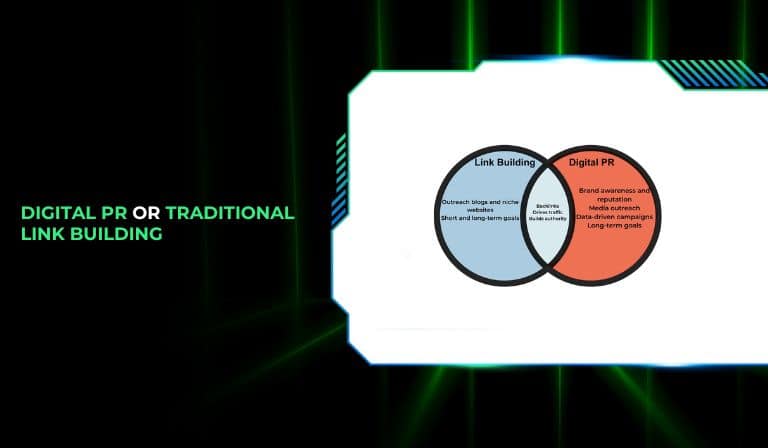
Digital PR in one line
Digital PR focuses on earning editorial mentions and links through stories, research, expert insights, and media coverage.
Traditional link building in one line
Traditional link building focuses on building backlinks intentionally through outreach, placements, guest posts, and link acquisition tactics.
The biggest difference
If you want a clean way to understand digital pr vs traditional link building, here it is:
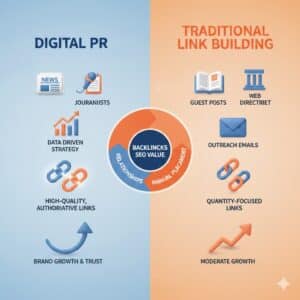
- Digital PR = brand authority + editorial trust + high-quality links
- Traditional link building = steady link growth + controlled strategy + scalable execution
What Is Digital PR in SEO?
Digital PR is one of the most powerful ways to earn high-quality backlinks today.
In simple terms, Digital PR is when you pitch your brand, content, or research to online publications, journalists, bloggers, and creators so that they mention you and link to your site naturally.
Unlike traditional link building, Digital PR isn’t only about links. It’s also about:
- Brand reputation
- Visibility across the web
- Building trust and authority
- Creating “signals” that help you win in competitive industries
Digital PR meaning (simple explanation)
Digital PR combines public relations + content marketing + SEO.
The goal is to create something newsworthy, valuable, or interesting and get it published across trusted websites.
Digital PR links are often called editorial backlinks, because they are placed naturally in articles that are written independently by publishers.
What you get from Digital PR
Digital PR can deliver multiple benefits at the same time:
1) High-authority backlinks
When a news website or high-traffic blog links to you, the SEO value is usually strong because:
- The site has authority
- The link is contextual
- The mention looks natural
This is why Digital PR is often considered “premium” backlink building.
2) Brand mentions (even without a link)
In 2026, brand mentions matter more than many SEOs think.
Even when a website mentions your brand but doesn’t link, that mention still builds trust and recognition.
3) Referral traffic
Unlike many traditional link placements, Digital PR can send real visitors to your website.
That means:
- More leads
- More signups
- More conversions
- More brand recall
4) Higher conversion rates
When people discover your brand through trusted media coverage, they are more likely to trust you.
This means Digital PR indirectly boosts performance across:
- SEO
- Google Ads
- Social media campaigns
- Retargeting
Traditional PR vs Digital PR: What’s the Difference?

Many people confuse traditional PR vs digital PR, but they are not the same.
Traditional PR
Traditional PR is focused on offline media or classic media channels such as:
- Newspapers
- TV
- Radio
- Physical magazines
- Press conferences and media events
It builds reputation, but it may not always create trackable SEO value.
Digital PR
Digital PR is focused on online media such as:
- News websites
- Industry blogs
- Online magazines
- Podcasts (with website pages)
- Digital publications
- Thought leadership platforms
Digital PR is far more measurable because you can track:
- Links earned
- Traffic from articles
- Authority gains
- Ranking improvements
The best part?
Digital PR helps both branding and SEO at the same time, which is why it’s growing fast in 2026.
Common Digital PR Campaign Types That Earn Links
One reason Digital PR outperforms many methods is that it’s not limited to one type of content.
Here are the most effective digital PR campaigns you can run today:
1) Data-driven research stories
If you want powerful editorial links, nothing beats original data.
Examples:
- Industry reports
- Surveys
- Market trends analysis
- Consumer behavior insights
- “State of the industry” research
Data-driven stories give journalists a reason to reference and cite you.
2) Newsjacking
This means reacting fast to a trending topic and offering commentary, insights, or analysis.
It works best when:
- Your industry has frequent updates
- You have expert opinions
- You can respond quickly
The key here is timing. If you’re late, the opportunity is gone.
3) Expert commentary and thought leadership
Journalists love quoting experts.
You can earn links by sharing:
- Opinions
- Predictions
- Unique frameworks
- Step-by-step explanations
Even one good expert quote can bring backlinks from big publications.
4) Company milestones and announcements
This works best when you have something genuinely newsworthy:
- Funding
- New product launch
- New partnership
- Major achievement
- Unique campaign
But the story must be relevant to the audience, not just promotional.
5) Case studies
Case studies earn links when they include:
- Real numbers
- Growth results
- A repeatable method
- A strong story
Publishers want results-based proof, not generic marketing talk.
What Is Traditional Link Building?
Traditional link building is the process of actively acquiring backlinks through planned outreach.
It’s direct, measurable, and can work well when done ethically.
Traditional link building is often used for:
- New websites that need foundational authority
- Brands that want predictable SEO growth
- Local businesses that need links quickly
- Websites that need backlinks for specific pages
Traditional link building meaning
Traditional link building is not “bad” or “spammy” by default.
It becomes risky only when:
- You buy links from low-quality sites
- You over-optimize anchor text
- You build irrelevant links in bulk
- You prioritize quantity over quality
When done correctly, traditional link building is still an essential part of modern SEO and backlink building
Common Traditional Link Building Methods (That Still Work in 2026)
Let’s break down the common methods so you know what’s effective and what should be avoided.
1) Guest posting
Guest posts work when:
- The website is relevant to your niche
- The article is high quality
- The link placement looks natural
- The site gets real traffic
Guest posting becomes useless when done on random sites created only for backlinks.
2) Resource page link building
Many websites have pages like:
- “Useful resources”
- “Top tools”
- “Best websites for…”
- “Recommended companies”
If your content genuinely fits, these are easy, natural links.
3) Broken link building
This method includes:
- Finding broken links on websites
- Offering your content as a replacement
- Helping the site fix their issue
It works best for evergreen content like guides and tutorials.
4) Niche edits (with caution)
Niche edits can be risky depending on the site quality.
If the link is inserted in an old article unnaturally, it may look manipulative.
But if the site is real and the addition improves the content, it can still work.
5) Local citations and business listings
For local businesses, citations are still a powerful form of foundational link building:
- Business directories
- Industry directories
- Location-based portals
This is a key part of local SEO and helps Google trust your business information.
Which Is Better in 2026: Digital PR or Traditional Link Building?
Now let’s answer the main question properly.
The truth is:
Neither strategy is automatically better. The better strategy depends on your goals, budget, timeline, and competition.
But to simplify your decision, let’s break it down.
When Digital PR Is Better
Digital PR works best when you want long-term brand strength and elite-level links.
1) When you want authority that competitors can’t copy
A good Digital PR link is hard to replicate.
Your competitor can’t easily “build the same link” because:
- It came from a story
- It was editorial
- It required research, insights, or timing
That’s why Digital PR creates a competitive edge.
2) When you want powerful editorial backlinks
Editorial backlinks are often:
- More trusted
- More natural
- More valuable over time
Digital PR delivers links that search engines expect real brands to earn.
3) When you want SEO + branding together
Traditional link building usually helps rankings.
Digital PR helps rankings and builds reputation, which supports:
- Higher CTR from Google results
- Better conversion rates
- Stronger trust in your service
4) When you’re in a competitive niche
Industries like finance, health, real estate, software, education, and marketing often need more than basic backlinks.
Digital PR helps you stand out with authority and visibility.
When Traditional Link Building Is Better
Traditional link building is still very useful, especially for structured growth.
1) When you need consistent backlink building
Digital PR can be unpredictable.
Some campaigns work big. Some fail.
Traditional link building gives you consistent monthly backlink acquisition and supports predictable progress.
2) When you’re a new website
New sites often need foundational backlinks to build trust.
A realistic strategy is:
- Start with traditional link building for baseline authority
- Add Digital PR once you have better content assets
3) When your budget is limited
Digital PR campaigns often require:
- Research
- Story creation
- Outreach
- Media pitching
- Strong copywriting
That can be expensive.
Traditional link building is easier to plan and budget monthly.
4) When local SEO is your main focus
Local businesses often need:
- Citations
- Local directories
- Nearby partnerships
- Local links
These are traditional but effective tactics that support map rankings and service page rankings.
The Best Answer: Most Businesses Need Both
In 2026, the winning strategy is almost always a hybrid.
Here’s why:
- Digital PR gives you authority, trust, and premium links
- Traditional link building gives you consistency, control, and stability
So instead of asking only “Which is better?” the smarter question becomes:
How should I combine Digital PR and traditional link building based on my goals?
A balanced monthly plan might look like:
- 70% traditional link building for steady growth
- 30% Digital PR campaigns for big authority boosts
Or if you’re a big brand:
- 70% Digital PR
- 30% foundational link building
Ask An SEO: What Links Should You Build For A Natural Backlink Profile?
A natural backlink profile is one that looks organic and realistic.
Google expects real businesses to earn a variety of links from different places, not the same type of link again and again.
What a natural backlink profile looks like
A healthy profile usually includes:
1) Branded anchor text
Example:
- “YourBrand”
- “YourBrand website”
- “YourBrand services”
2) Generic anchor text
Example:
- “click here”
- “read more”
- “this website”
3) Partial match anchors
Example:
- “backlink building strategies”
- “digital PR campaigns for SEO”
4) Mixed dofollow and nofollow links
Many PR links are nofollow, and that’s normal.
A profile with only dofollow links can look unnatural.
5) Links to different pages
You should have links pointing to:
- Homepage
- Service pages
- Blog posts
- Tools or resources
- Case studies
If every backlink points only to your money page, it looks manipulative.
Links That Matter Most in 2026
Not all links have equal value. In 2026, quality beats quantity more than ever.
Here are the links that matter most:
1) Editorial links from real publications
These links bring:
- authority
- visibility
- trust
Digital PR is best for earning these.
2) Contextual links from niche-relevant blogs
A relevant site with real traffic is far better than a high-metric site with no audience.
3) Local links for local businesses
Local SEO links include:
- local newspapers
- city blogs
- community websites
- business associations
4) Resource links and list placements
These links are evergreen and can keep sending traffic for years.
Links You Should Avoid in 2026
Bad links can destroy your progress.
Avoid:
- Spammy directories with no real moderation
- Unrelated sites accepting “any topic” guest posts
- Over-optimized anchor text like exact-match keywords every time
- Paid links placed in irrelevant articles
- Automated link building tools that create hundreds of low-quality links
A good rule is simple:
If the website looks fake, has no real audience, and exists only to sell backlinks, stay away.
Sources To Get Digital PR Mentions And Links
Digital PR is about getting featured and mentioned online.
Here are strong sources that can earn you coverage:
1) Industry blogs and online magazines
Most industries have websites that publish:
- trends
- insights
- expert opinions
- case studies
If your content is valuable, you can pitch editors and earn mentions.
2) Journalist request opportunities
Many journalists actively request:
- expert quotes
- insights
- opinions
This is one of the fastest ways to earn Digital PR links.
3) Podcasts and interview pages
Podcasts often have guest pages with backlinks.
Even if the link is nofollow, it still builds authority and brand visibility.
4) Community websites and newsletters
Online newsletters are becoming powerful.
Getting featured can drive traffic quickly and support brand searches.
Achieving Links That Matter: How To Use Research And Data-Driven Journalism
If you want premium Digital PR links consistently, you need to think like a publisher.
Here’s how to do it.
Step 1: Choose a topic people already care about
Data works best when it matches an existing market interest:
- salary trends
- consumer behavior
- AI impact
- marketing budgets
- industry growth
Step 2: Create original insights
You can create data by:
- running surveys
- collecting internal customer data (anonymized)
- analyzing public datasets
- doing comparison studies
Step 3: Build a story, not just a report
Journalists don’t want spreadsheets.
They want:
- headlines
- shocking stats
- key insights
- clear conclusions
Step 4: Pitch the right publications
One common mistake is pitching everyone.
A better strategy is:
- Pitch niche publications first
- Then move to bigger ones
- Offer exclusives when needed
This increases acceptance.
Experts vs Influencers: Digital PR Alternatives To Link Building
There’s another angle many brands miss: authority doesn’t always come only from links.
Expert-led Digital PR
This includes:
- Founder interviews
- Opinion pieces
- Thought leadership content
- Insight-driven commentary
Benefits:
- Builds strong brand credibility
- Earns high trust links naturally
- Works well for B2B
Influencer-driven visibility
Influencers may not always give SEO backlinks, but they help with:
- brand searches
- awareness
- direct traffic
- social proof
In 2026, awareness impacts SEO indirectly because trusted brands get more clicks and more conversions.
The smart play is to combine:
- Expert authority for trust
- Influencer reach for scale
The State of AEO & GEO in 2026: Why This Matters for Links
SEO is no longer only “rank on Google and win clicks.”
In 2026, users discover brands through:
- AI-generated answers
- voice search
- local packs
- summaries and overviews
- community-based results
That’s why AEO and GEO are becoming important.
What AEO means
AEO stands for Answer Engine Optimization.
The goal is to make your content easy to understand, easy to trust, and easy to extract into answers.
What GEO means
GEO stands for Generative Engine Optimization.
It focuses on increasing the chances that AI tools cite your brand, mention your website, and trust your expertise.
Why Digital PR helps AEO and GEO
Digital PR helps because AI tools and modern algorithms trust brands that are:
- mentioned across the web
- cited by authoritative sites
- recognized as real entities
So even when Digital PR links are nofollow, the mention still helps build authority signals.
Local AEO Best Practices for Small Businesses in 2026
Local businesses don’t always need national PR.
But local Digital PR can be extremely powerful.
How Digital PR helps local businesses
- Local news features
- Community event mentions
- Local business awards
- Local partnerships
These build:
- local trust
- local backlinks
- real reputation
Traditional link building for local SEO
Traditional link building works for local businesses through:
- local citations
- directory listings
- local bloggers
- chamber of commerce links
The combination that wins locally
Local SEO growth in 2026 depends on:
- strong business profile signals
- local relevance
- trusted mentions
- consistent backlink building
5 Ways To Reduce CPL, Improve Conversion Rates & Capture More Demand In 2026
Now let’s connect links and PR to what businesses really care about: leads and revenue.
1) Build trust before the click
Digital PR creates recognition.
When users already know your brand, they convert faster.
2) Improve landing page credibility
If your landing page features:
- media logos
- mentions
- awards
- credibility points
Your conversion rate often improves.
3) Rank for high-intent keywords
Traditional link building helps you rank consistently, especially for:
- service keywords
- “best” keywords
- comparison searches
4) Capture demand, not just create demand
Digital PR creates awareness.
Traditional link building captures it through rankings.
5) Use PR content in ads
PR coverage can become ad creatives:
- “Featured in…”
- “Trusted by…”
- “As seen on…”
This can reduce CPL because people trust the offer more.
The Guide To Winning More Business Online In 2026
If you want a strong plan that works in real life, here’s a clear framework:
Step 1: Understand what are the four types of SEO
A lot of businesses don’t scale SEO because they focus on only one part.
So, what are the four types of SEO?
1) On-page SEO
Optimizing your content, including:
- headings
- keywords
- structure
- internal links
- user experience
2) Off-page SEO
Everything outside your website that impacts trust, such as:
- backlinks
- brand mentions
- Digital PR
- reviews and references
3) Technical SEO
Improving your site health, including:
- speed
- crawlability
- indexing
- mobile experience
- structured data
4) Local SEO
Focused on location-based visibility using:
- Google Business Profile
- NAP consistency
- local citations
- location pages
Digital PR and traditional link building mainly fall under off-page SEO, but they support every other SEO type indirectly.
Step 2: Build content that deserves links
The best way to earn quality links is to publish:
- guides
- case studies
- tools
- original research
- comparison content
Step 3: Use a hybrid authority strategy
Use both:
- Digital PR for authority signals
- Traditional link building for consistent ranking improvements
Step 4: Track what matters
Measure:
- referring domains growth
- keyword rankings
- conversions from organic traffic
- leads influenced by PR coverage
The Ultimate AEO & GEO Benchmarks Resource (What to Track)
If you want results, you need tracking.
Metrics to track for Digital PR
- Mentions earned
- Quality of publications
- Referral traffic from PR
- Brand search growth
- Conversion improvements after media coverage
Metrics to track for traditional link building
- New referring domains
- Topical relevance of links
- Anchor text distribution
- Growth over time (no spikes)
- Rankings of target pages
A brand that grows authority naturally improves rankings across the board.
Conclusion
So, Digital PR or traditional link building — which is better?
Here’s the honest answer:
- Digital PR is better for long-term authority, trust, and premium editorial links
- Traditional link building is better for consistent growth, scalability, and planned backlink building
- The best strategy in 2026 is combining both
If you want fast progress with stability, build a strong base using traditional link building.
If you want your brand to become trusted, recognized, and unshakable in rankings, invest in Digital PR consistently.
In the end, SEO success is not about choosing one tactic.
It’s about building a brand that earns visibility, links, and trust from every direction.
FAQs
1) Is Digital PR safer than traditional link building?
Yes, Digital PR is generally safer because editorial links are naturally earned, not artificially placed. But bad PR outreach can still fail if the content is not newsworthy.
2) Does traditional link building still work in 2026?
Yes. Ethical traditional link building still works well, especially when links come from relevant, real websites with genuine audiences.
3) Which is better for a new website?
Traditional link building is usually better at the start because you can build foundational authority faster. Once your site has content and credibility, Digital PR becomes more effective.
4) How many backlinks should I build every month?
There is no fixed number. Focus on:
- relevance
- quality
- consistency
Even a small number of strong links every month can outperform large volumes of weak links.