



The role of a marketing manager has evolved rapidly with the rise of digital channels, AI tools, and changing customer expectations. Today, marketing managers operate at the intersection of strategy, execution, analytics, and leadership. They are expected to understand data, guide teams, collaborate with sales and product, and demonstrate clear ROI on every initiative.

This blog explores 11 essential skills that differentiate high-performing marketing leaders from average practitioners. These skills span hard capabilities like analytics and automation, and soft skills like communication and adaptability, giving you a clear roadmap for upskilling and career advancement.
HARD SKILLS SECTION
Hard skills are the technical capabilities that allow marketing managers to plan, execute, and measure campaigns effectively. These skills are usually tool-based, measurable, and closely tied to performance metrics.
Skill #1: Data Analytics & KPI Tracking

Data analytics and KPI tracking enable marketing managers to move from intuition-based decisions to evidence-based strategies. Rather than guessing what works, managers use metrics to understand which channels, messages, and audiences drive results.
Data-driven marketing is consistently linked with higher ROI and more efficient spend allocation because it allows teams to double down on effective tactics and quickly cut underperforming ones.
Key technical competencies:
- Interpreting data from analytics platforms (e.g., traffic, engagement, conversion, retention metrics).
- Defining and tracking KPIs such as cost per acquisition (CPA), customer lifetime value (CLV), return on ad spend (ROAS), and conversion rate.
- Building dashboards and reports that summarize performance for stakeholders and leadership.
- Identifying trends, anomalies, and patterns in campaign data to inform optimization decisions.
- Understanding attribution basics (which channels or touchpoints contribute most to conversions).
Real-world application:
A marketing manager might notice that a specific campaign is generating high traffic but low conversions. By analyzing bounce rate, session duration, and funnel drop-off points, they can identify whether the problem lies in targeting, messaging, landing page UX, or offer quality. This allows precise changes instead of broad, unfocused adjustments.
Tools to master:
- Google Analytics or GA4 for web and conversion tracking.
- Excel or Google Sheets for calculations, pivot tables, and lightweight dashboards.
- Visualization tools like Tableau or Power BI for more advanced reporting.
Skill #2: SEO & Content Marketing Expertise

SEO and content marketing help brands attract qualified traffic organically, without relying solely on paid advertising. For marketing managers, these skills are essential for long-term, compounding growth.
Content and SEO work together: high-quality content answers audience questions, while SEO ensures people can find that content through search engines.
Key technical competencies:
- Conducting keyword research to identify topics and queries aligned with buyer intent.
- Planning content strategies that support the full funnel (awareness, consideration, decision).
- Applying on-page SEO best practices such as meta tags, headings, internal linking, and structured content.
- Coordinating with writers, designers, and SEO specialists to produce and optimize content across formats (blogs, guides, landing pages, videos).
- Understanding backlinks and basic off-page SEO to support authority-building.
Real-world application:
A marketing manager may plan a cluster of blog posts targeting “marketing manager skills,” “marketing leadership competencies,” and “data-driven marketing,” then internally link them to a central resource or landing page. Over time, this structure can increase search rankings and generate consistent, relevant traffic.
Tools to master:
- Keyword and competitor tools like Ahrefs, Semrush, or similar platforms.
- Google Search Console for monitoring search performance and indexing issues.
- Content management systems (CMS) like WordPress or HubSpot CMS to publish and manage content.
Skill #3: Digital Marketing Mastery

Digital marketing mastery means understanding how different online channels work together to reach, engage, and convert audiences. For marketing managers, this skill is about orchestrating multiple channels into a coherent, measurable strategy.
Instead of focusing on a single platform, effective leaders think in terms of customer journeys across search, social, email, and paid media.
Key technical competencies:
- Search Engine Marketing (SEM) and pay-per-click (PPC) campaigns on platforms like Google Ads.
- Social media marketing across major platforms, including both organic content and paid campaigns.
- Email marketing strategy, including list building, segmentation, and automated sequences.
- Basic understanding of display advertising, remarketing, and video ads.
- Aligning messaging and creative assets across multiple channels for consistency.
Real-world application:
A marketing manager launching a new product might coordinate a multi-channel campaign involving search ads, social ads, a launch email sequence, supporting blog content, and remarketing ads to site visitors. Performance from each channel is monitored and optimized over the campaign period.
Tools to master:
- Google Ads and similar ad platforms.
- Facebook/Meta Ads Manager and LinkedIn Campaign Manager for social paid media.
- Email marketing tools like Mailchimp, Klaviyo, or HubSpot.
Skill #4: E-Commerce & Conversion Rate Optimization

For any brand with online transactions or lead capture, understanding e-commerce fundamentals and conversion rate optimization (CRO) is critical. Marketing managers must ensure that the traffic they generate actually turns into revenue or high-quality leads.
CRO focuses on improving key on-site actions – such as purchases, demo requests, or sign-ups – by optimizing user experience, messaging, and friction points.
Key technical competencies:
- Analyzing conversion funnels to see where users drop off (e.g., product view → cart → checkout).
- Structuring product or service pages with clear value propositions, social proof, and calls-to-action.
- Running A/B tests on headlines, layouts, forms, and CTAs to identify higher-performing variations.
- Understanding basic UX principles that affect conversion, such as clarity, load speed, and mobile responsiveness.
- Using quantitative data (analytics) and qualitative data (session recordings, heatmaps) to find issues and opportunities.
Real-world application:
Suppose a checkout page has a high abandonment rate. A marketing manager might review form length, page speed, trust signals (security badges, guarantees), and clarity of pricing, then test improvements. Even small conversion gains can significantly increase revenue at scale.
Tools to master:
- E-commerce platforms like Shopify, WooCommerce, or similar.
- CRO tools like Google Optimize (or equivalents) and Hotjar-type tools for heatmaps and session recordings.
Skill #5: Marketing Automation & CRM Systems
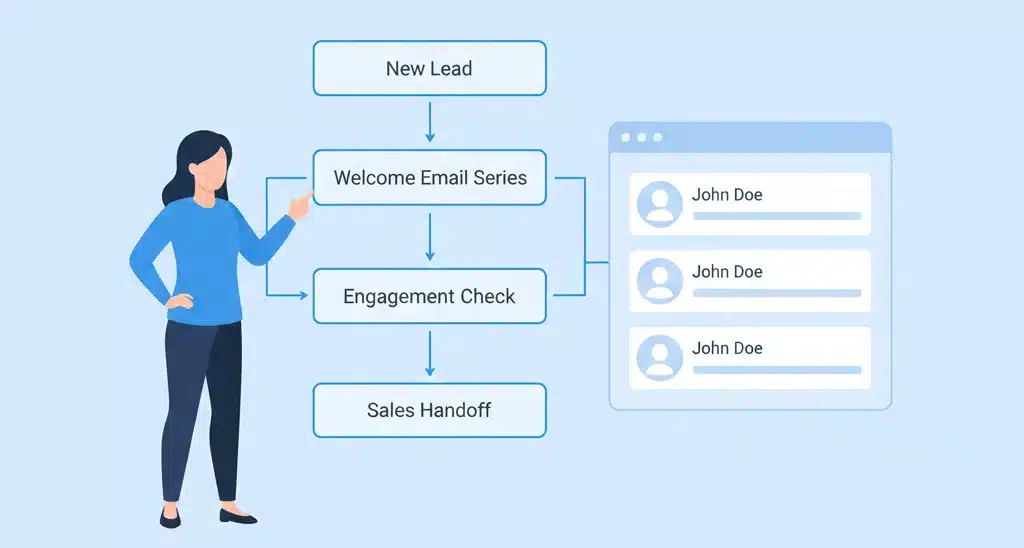
Marketing automation and CRM skills allow marketing managers to scale communication and nurture leads efficiently. These systems help ensure that every lead and customer gets timely, relevant messages based on their behavior and lifecycle stage.
They also create a shared source of truth for marketing and sales teams, improving alignment and handoff quality.
Key technical competencies:
- Setting up automated workflows such as welcome sequences, lead nurturing, and re-engagement campaigns.
- Understanding lead scoring models to prioritize high-intent contacts for sales outreach.
- Managing lists, segments, and lifecycle stages in a CRM or marketing automation platform.
- Tracking interactions across email, website, and sales touchpoints within a unified system.
- Producing CRM-based reports that show pipeline, opportunities, and campaign-influenced revenue.
Real-world application:
A marketing manager might build a workflow where leads who download a guide receive a sequence of educational emails, followed by a personalized offer, and are only passed to sales once they meet engagement or fit thresholds. This improves conversion quality and sales efficiency.
Tools to master:
- CRM platforms such as HubSpot CRM, Salesforce, or similar systems.
- Marketing automation tools integrated with CRM (e.g., HubSpot Marketing Hub, Marketo, ActiveCampaign).
Skill #6: Market Research & Consumer Insights
Market research and consumer insights give marketing managers a grounded understanding of who their customers are, what they care about, and how they make decisions. This insight informs everything from messaging to channel strategy.
Without clear insight into customer needs and behavior, even technically well-executed campaigns can miss the mark.
Key technical competencies:
- Designing and analyzing quantitative research such as surveys and polls.
- Conducting qualitative research through interviews, focus groups, or customer calls.
- Developing buyer personas and customer segments based on data rather than assumptions.
- Performing competitor analysis to understand positioning, offers, and messaging in the market.
- Using secondary research (industry reports, trend data) to validate and enhance findings.
Real-world application:
A marketing manager might use surveys to understand why existing customers chose the brand, then refine messaging to highlight those same decision drivers in acquisition campaigns. This can increase resonance and conversion rates across channels.
Tools to master:
- Survey tools like SurveyMonkey or Typeform.
- Trend and search tools like Google Trends and keyword research platforms.
Skill #7: Project Management & Time Mastery
Marketing managers often oversee multiple campaigns, stakeholders, and deadlines at once. Strong project management ensures work is delivered on time, on brief, and within budget.
Effective project management also reduces stress and confusion across teams, enabling better collaboration and output quality.
Key technical competencies:
- Breaking down campaigns into tasks, milestones, and timelines.
- Allocating resources across internal teams, agencies, and freelancers.
- Monitoring progress, identifying blockers, and adjusting plans as needed.
- Managing budgets, scope, and expectations with stakeholders.
- Using project management tools to maintain visibility and accountability.
Real-world application:
For a quarterly campaign, a marketing manager might create a timeline covering strategy, creative production, approvals, launch, optimization, and reporting. Each step is assigned a responsible owner and deadline, reducing last-minute surprises.
Tools to master:
- Platforms like Asana, Trello, Monday.com, or similar.
- Shared documentation tools such as Google Workspace or Notion for briefs and plans.
SOFT SKILLS SECTION
Soft skills enable marketing managers to lead teams, influence stakeholders, and navigate complexity. While harder to quantify, they strongly correlate with leadership effectiveness and career progression.
Skill #8: Strategic Leadership & Team Management

Strategic leadership is about more than assigning tasks; it involves setting direction, aligning people around shared goals, and empowering teams to deliver their best work. For marketing managers, this includes connecting day-to-day activities with broader business objectives.
Team management requires balancing coaching, accountability, and support so that individuals can grow while the team consistently delivers.
Core competencies:
- Setting clear, measurable goals for the team that tie to business outcomes.
- Delegating work based on strengths and capacity, rather than trying to do everything personally.
- Providing constructive feedback and mentorship to help team members develop.
- Handling conflict or misalignment in a fair and structured way.
- Representing the marketing function credibly in leadership discussions.
Real-world application:
A marketing manager might translate a company-level revenue objective into specific lead and pipeline targets, then into channel-specific goals for the team. Regular check-ins focus on removing obstacles and coaching, not just status updates.
Skill #9: Communication Excellence
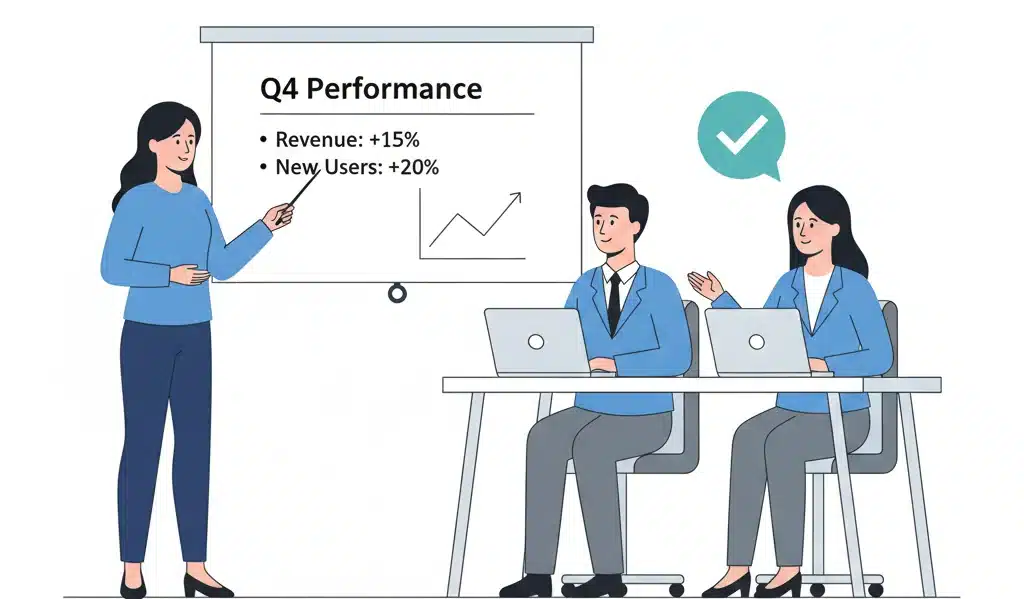
Communication excellence is central to the marketing manager role, both internally and externally. Managers must translate complex data into clear narratives, align cross-functional stakeholders, and ensure their teams understand priorities and context.
Externally, they contribute to messaging that resonates with customers, so the same communication skill set reinforces both leadership and campaign effectiveness.
Core competencies:
- Writing clear, concise emails, briefs, and documentation that reduce ambiguity.
- Presenting campaign plans and performance updates to executives in an accessible, outcome-focused way.
- Explaining what data means and why it matters to non-technical stakeholders.
- Actively listening to team members, peers, and customers to understand their concerns and perspectives.
- Collaborating effectively with sales, product, finance, and other departments to align on goals and trade-offs.
Real-world application:
After a campaign, a marketing manager might prepare a concise presentation that highlights objectives, key metrics, what worked, what did not, and next steps. This builds trust with leadership and ensures future budgets are informed by clear learning.
Skill #10: Critical Thinking & Problem-Solving
Marketing environments are full of uncertainty: changing algorithms, new competitors, shifting customer preferences. Critical thinking and problem-solving enable marketing managers to respond thoughtfully rather than reactively.
Instead of chasing every new tactic, strong leaders analyze context, identify root causes, and design practical solutions.
Core competencies:
- Diagnosing issues using data and qualitative input (e.g., performance drops, channel fatigue).
- Evaluating multiple options and trade-offs before committing to a course of action.
- Balancing short-term performance needs with long-term brand and relationship goals.
- Reflecting on failed experiments to extract learning and improve future decisions.
- Applying structured thinking to complex problems, such as market shifts or budget constraints.
Real-world application:
If lead quality declines, a marketing manager might examine changes in targeting, messaging, channels, or offer type instead of assuming one obvious cause. This structured approach helps fix the actual problem instead of treating symptoms.
Skill #11: Adaptability & Continuous Learning

Marketing changes frequently: new platforms emerge, privacy regulations evolve, and AI tools reshape workflows. Adaptability and continuous learning allow marketing managers to stay valuable and effective in this shifting landscape.
Rather than waiting for change to happen, top leaders proactively update their skills, test new approaches, and refine their strategies.
Core competencies:
- Staying informed about industry trends, platform updates, and new tools through reputable sources.
- Experimenting with new tactics in controlled ways, learning from both wins and failures.
- Adjusting strategies when data shows that a channel or approach is no longer effective.
- Developing basic fluency with AI-driven tools and automation that impact marketing workflows.
- Building a personal learning system (courses, books, communities, events) to maintain momentum over time.
Real-world application:
A marketing manager might experiment with AI tools to assist in data analysis or creative ideation while still validating outputs and maintaining strategic control. This can increase efficiency without sacrificing quality.
Integrating Hard and Soft Skills
Hard and soft skills are most powerful when combined. Technical skills like analytics and automation provide the “what” and “how,” while leadership, communication, and adaptability shape the “why” and “who.”
For example, data analytics without communication leads to insights that no one acts on, while strong communication without data risks persuasive but misinformed decisions. Effective marketing managers use soft skills to influence stakeholders and hard skills to ground their recommendations in evidence.
In practice, this integration might look like leading a cross-functional workshop where a manager uses analytics to highlight a problem, facilitates structured discussion, and then collaborates on a solution and implementation plan. This approach builds alignment and momentum.
Implementation Roadmap for Career Advancement
Developing these 11 skills is a continuous process rather than a one-time project. Treat your growth as a structured program, similar to how you would plan a campaign.
Start by honestly assessing your current strengths and gaps across both hard and soft skills. Then prioritize the skills that most directly impact your current role, future goals, and organization’s needs.
Practical steps for implementation:
- Map your current proficiency in each of the 11 skills on a simple scale (e.g., beginner, intermediate, advanced).
- Choose 2–3 high-impact skills to focus on over the next quarter, balancing one hard and one soft skill where possible.
- Identify specific learning resources such as courses, certifications, or internal projects that can help you practice these skills on real work.
- Schedule regular reviews (monthly or quarterly) to track progress, update goals, and refine your development plan.
Over time, this deliberate approach builds a strong, well-rounded skill set rather than scattered, unconnected learning.
Industry-Specific Applications
While the core 11 skills apply broadly, how they show up can differ by industry. Understanding these nuances helps marketing managers tailor their development to their context.
In technology and SaaS, there is often a stronger emphasis on product marketing, recurring revenue metrics, and tight alignment with sales and customer success teams. In e-commerce, CRO and performance marketing play a larger role, while B2B services often lean heavily on content, thought leadership, and relationship-building.
Recognizing these variations allows marketing managers to prioritize specific tools, channels, and frameworks without losing sight of the universal leadership and analytical skills that underpin success.
Conclusion
The top 11 marketing manager skills every leader needs span analytics, digital execution, market understanding, leadership, communication, problem-solving, and continuous learning. Together, they enable marketing managers to design effective strategies, lead teams, and demonstrate tangible business value in a rapidly changing environment.
Building these skills is not an overnight effort, but a structured, ongoing process. By assessing your current capabilities, prioritizing key areas, and committing to steady improvement, you can position yourself as a high-impact marketing leader ready for the demands of 2026 and beyond.

Passionate about blogging and focused on elevating brand visibility through strategic SEO and digital marketing. Always tuned in to the latest trends, I’m dedicated to maximizing engagement and delivering measurable ROI in the dynamic world of digital marketing. Let’s connect and unlock new opportunities together!