


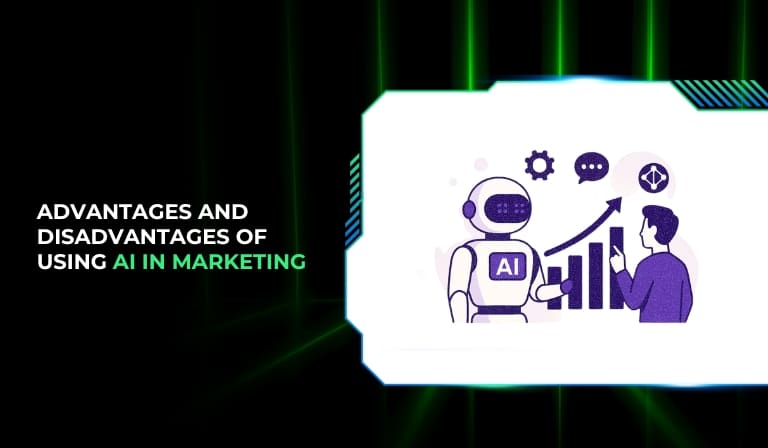
Artificial Intelligence (AI) is no longer just a buzzword—it has become a powerful part of modern marketing. From personalized recommendations on shopping sites to automated chatbots answering customer questions, AI is everywhere. Businesses are turning to AI because it helps them save time, reach more people, and make smarter decisions.
But like every new technology, AI also has its challenges. While it offers many benefits, it also comes with risks and disadvantages that businesses must consider.
This complete guide will explain what AI in marketing is, its advantages, disadvantages, best practices, and the future ahead.
What Is AI in Marketing?
AI in marketing refers to the use of machine learning, data analysis, and automation tools to improve marketing efforts. Instead of relying only on human judgment, businesses can use AI to analyze huge amounts of data, predict customer behavior, and even interact with customers in real-time.
Examples of AI in Marketing:
- Chatbots that provide instant customer service.
- Predictive analytics that forecasts what customers will buy next.
- Recommendation engines like those used by Amazon and Netflix.
- Automated ad placements that optimize campaigns in real time.
- Voice assistants like Siri and Alexa that respond to customer queries.
AI blends into almost every area of digital marketing, making campaigns smarter and more efficient.
Advantages of Using AI in Marketing
1. Enhanced Customer Insights and Personalization
AI can analyze customer data such as browsing habits, purchase history, and social media activity. This allows businesses to create highly personalized experiences, like product suggestions or tailored email campaigns. Customers feel valued when they receive relevant offers, which often leads to higher engagement and loyalty.
2. Improved Efficiency and Automation
Repetitive tasks such as sending follow-up emails, scheduling social media posts, and running ads can take up a lot of time. AI automates these tasks, freeing up marketers to focus on strategy and creativity. This leads to better time management and cost savings.
3. Predictive Analytics and Better Decision-Making
One of the strongest benefits of AI is its ability to predict future customer behavior. For example, AI can identify which products are likely to trend or which customers are most likely to churn. With this insight, marketers can make smarter, data-driven decisions.
4. Real-Time Customer Support
AI-powered chatbots can provide 24/7 support, answering customer questions instantly. This not only improves the customer experience but also reduces the pressure on human support teams.
5. Higher ROI and Performance Tracking
AI tools can optimize digital ad campaigns in real-time, ensuring the right people see the right ads at the right time. They also track performance, showing what works and what doesn’t. This results in better return on investment (ROI).
6. Scalability in Marketing Campaigns
AI allows businesses to scale their marketing without significantly increasing costs. Whether targeting thousands or millions of people, AI can handle campaigns efficiently while still personalizing messages for each customer segment.
Disadvantages of Using AI in Marketing
1. High Implementation Costs
Although AI tools can save money in the long run, the initial investment is often expensive. Businesses need to purchase software, integrate systems, and train staff. For small businesses, this can be a challenge.
2. Data Privacy and Security Concerns
AI relies on customer data to work effectively. This raises concerns about data privacy and security. If data is misused or exposed in a breach, it can damage customer trust and harm a brand’s reputation.
3. Lack of Human Touch
AI is excellent at processing data, but it lacks emotional intelligence. Over-reliance on AI may lead to robotic and impersonal communication. Customers still want authentic, human connections with brands.
4. Dependence on Data Quality
AI is only as good as the data it uses. If the data is inaccurate, outdated, or biased, the results will also be flawed. Poor-quality data can lead to wrong predictions and ineffective marketing.
5. Ethical and Bias Issues
AI systems can unintentionally reinforce bias. For example, if the data used to train an algorithm is biased, it may target or exclude certain groups unfairly. This raises serious ethical questions in marketing.
6. Limited Creativity
AI can generate ideas, write basic content, and suggest strategies, but it cannot fully understand emotions, culture, or storytelling. Human creativity is still essential for branding, campaigns, and emotional connection.
Best Practices for Using AI in Marketing
To get the most out of AI, businesses should follow some best practices:
- Start small and scale gradually: Begin with simple AI tools like chatbots or automated email campaigns before moving to advanced predictive analytics.
- Combine AI with human expertise: AI should support human decision-making, not replace it. A balance between automation and creativity is key.
- Maintain transparency with customers: Inform customers when AI is being used, especially in chatbots or data-driven personalization.
- Regularly audit AI systems: Check for errors, bias, and accuracy to ensure fairness and effectiveness.
- Protect customer data: Use strong data protection measures to build trust and comply with privacy regulations.
Conclusion
AI in marketing is transforming the way businesses connect with customers. The advantages—like personalization, efficiency, and real-time support—are clear. At the same time, the disadvantages—such as high costs, privacy concerns, and lack of creativity—cannot be ignored.
The key is balance. Businesses should use AI as a tool to enhance marketing, while still relying on human creativity and judgment to maintain authenticity.
By adopting AI responsibly, companies can unlock its full potential and build stronger, smarter, and more ethical marketing strategies.

Passionate about blogging and focused on elevating brand visibility through strategic SEO and digital marketing. Always tuned in to the latest trends, I’m dedicated to maximizing engagement and delivering measurable ROI in the dynamic world of digital marketing. Let’s connect and unlock new opportunities together!