



China’s online marketplace is massive, and if you’re planning to enter it, you need to understand how search works there. Unlike most of the world, where Google is the dominant player, Chinese users rely on domestic search platforms. These Chinese search engines are built to comply with local regulations, consumer behavior, and market needs.

If you’re looking for a Chinese engine search to target your audience, this guide breaks down the top 5 players and how they work.
The Internet and Censorship in China
China has the world’s largest online population, with over 1 billion internet users. But the country also has one of the strictest internet censorship frameworks, often called The Great Firewall.
- Google’s history in China: Although Google officially entered the Chinese mainland in 2006, it exited in 2010 due to censorship conflicts. Since then, most Google domains have been blocked.
- Why censorship matters: To control online information, the government mandates filters on devices sold in China. Many global platforms, including social media and streaming sites, remain restricted.
- VPN loophole: Some Chinese citizens use VPNs to bypass restrictions, but this is not a reliable way for businesses to reach Chinese users.
That’s why Chinese search engines like Google alternatives emerged—to serve the local population and comply with regulations.
Will Google Return to China?
There has long been speculation that Google may attempt a return. In 2018, reports surfaced about a censored project code-named “Dragonfly.” However, after backlash from employees and global critics, the project was abandoned.
For now, Google remains on the sidelines, leaving the market to homegrown Chinese search platforms that dominate the space.
How Chinese Consumers Shop Online
Understanding consumer behavior is essential before optimizing for a Chinese engine search:
- Mobile-first market: 99.9% of Chinese internet users access the web through smartphones. Search, shopping, and payments all revolve around mobile.
- Super-app culture: Unlike Western countries where people go directly to brand websites, Chinese users prefer all-in-one platforms like WeChat, Taobao, and Tmall.
- Shopping + entertainment: The line between social media, entertainment, and shopping is blurred. For example, you can see a product in a livestream and buy it instantly.
- Influencer-driven decisions: Recommendations from influencers and social media weigh heavily in purchase decisions.
- Customer service: Businesses that provide responsive customer service see higher loyalty.
This unique behavior also influences how Chinese search engines rank and present results.
Top 5 Chinese Search Engines
Let’s look at the top 5 Chinese search engines like Google and how they work:
1. Baidu – China’s Answer to Google
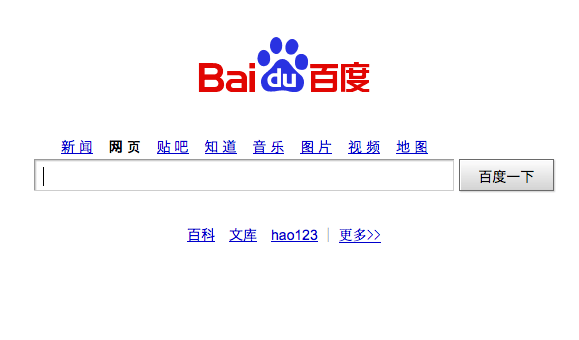
Baidu is the leading Chinese search engine, controlling more than 50% of the market.
Key facts about Baidu:
- Founded in 2000 with Silicon Valley backing.
- Expanded beyond search into AI, maps, cloud, and self-driving tech.
- Popular enough that “to Baidu” something is a verb in China, just like “to Google” elsewhere.
SEO considerations for Baidu:
- Websites must be in simplified Chinese. English-only content won’t rank.
- Preference for websites hosted on Chinese servers with an ICP license.
- Keywords in meta tags still matter, unlike on Google.
- Baidu struggles with JavaScript—so stick to plain HTML.
- Factors like loading speed, HTTPS, and content quality also influence rankings.
Baidu is the go-to Chinese search platform for both users and marketers.
2. Haosuo (Qihoo 360 Search) – Secure Search

Haosuo, also known as 360 Search, ranks among the top three Asian search engines. Backed by Qihoo 360, a major internet security company, it emphasizes safe browsing.
Why Haosuo matters:
- Comes pre-installed on many Chinese computers.
- Favored by companies for its security reputation.
- Stronger presence in B2B search marketing.
- Less competition than Baidu, meaning lower CPC for ads.
For businesses looking for affordable advertising options, Haosuo is a reliable Chinese search engine alternative.
3. Sogou – Search Dog
Sogou (literally “search dog”) is the second-most popular Chinese engine search, holding nearly 5% market share. It became part of Tencent in 2021, integrating deeply with its ecosystem.
SEO insights for Sogou:
- Prefers original, authoritative content.
- Simplified Chinese content and local hosting recommended.
- Backlinks matter—a higher quantity can boost ranking.
- Title tags are critical, while meta descriptions carry less weight.
- Integrated with Tencent apps like WeChat and QQ Messenger, giving it unique reach.
For marketers, optimizing for Sogou can unlock visibility inside Tencent’s vast social media and gaming platforms.
4. Shenma – Mobile-First Search

Shenma is unique among Chinese search engines because it’s mobile-only. It was created by Alibaba and UC Web.
Why Shenma stands out:
- Integrated into the UC Browser, one of China’s most popular browsers.
- Focused on mobile search + app discovery.
- Prioritizes e-commerce products listed on Taobao and Tmall.
- Widely used for categories like home goods, clothing, books, and apps.
For businesses in retail and consumer goods, Shenma is a powerful channel to reach mobile shoppers.
5. Youdao – The Translation Search Engine

Unlike traditional Chinese search engines like Google, Youdao specializes in translation and education.
Key features of Youdao:
- Operated by NetEase, a Chinese internet giant.
- Translates Mandarin into 20+ languages.
- Offers dictionary features, word usage examples, and educational content.
- Popular among students and young professionals—over half of users are under 24.
For foreign businesses selling international or educational products, Youdao provides a targeted entry point.
Getting Started with SEO in China
Breaking into Chinese search rankings isn’t easy. Here’s what you need to keep in mind:
- Language localization – Always create content in simplified Chinese.
- Hosting in China – For better rankings, host your site locally and get an ICP license.
- Mobile-first strategy – Optimize for smartphones, since that’s where most searches happen.
- Super-app integration – Consider visibility in platforms like WeChat, QQ, and Taobao.
- Different ranking signals – Baidu still considers keywords and metadata, unlike Google.
With over 1 billion internet users, the effort is worth it. Each Chinese engine search offers unique opportunities for international companies.
Conclusion
China’s search ecosystem is very different from the West. While Baidu dominates, alternatives like Haosuo, Sogou, Shenma, and Youdao each serve specific niches.
If you’re aiming to expand into China, don’t just think of Google. Instead, adapt your SEO strategies for these Chinese search engines like Google alternatives and align with Chinese consumer behavior.
With the right approach, you can unlock massive opportunities in the world’s largest online market.
FAQs
Which is the most popular Chinese search engine?
Baidu is the market leader, controlling over 50% of China’s search market.
Can I use Google in China?
Google is blocked in mainland China. Some people use VPNs, but for SEO and marketing, you must rely on domestic Chinese search engines.
What is a good Chinese search engine like Google?
Baidu is the closest equivalent to Google. Other strong options are Sogou (linked to Tencent) and Shenma (mobile-only).
Do I need a Chinese website to rank?
Yes. Sites must use simplified Chinese and ideally be hosted in China with an ICP license.
What’s the best strategy for SEO in China?
Focus on Baidu SEO, create mobile-first content, use simplified Chinese, and leverage super-app ecosystems like WeChat and Taobao.

An avid blogger, dedicated to boosting brand presence, optimizing SEO, and delivering results in digital marketing. With a keen eye for trends, he’s committed to driving engagement and ROI in the ever-evolving digital landscape. Let’s connect and explore digital possibilities together.