


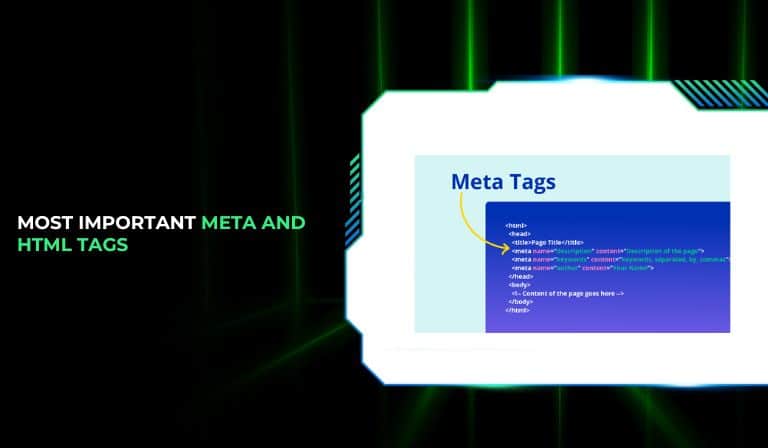
HTML meta tags are an essential part of on-page SEO, helping search engines and users understand your page’s content. While they may not have the direct ranking power they once did, they still play a crucial role in enhancing user experience, improving click-through rates (CTR), and ensuring that your content appears correctly in search engine results. Here, we will dive into the most important meta and HTML tags every SEO professional needs to know.

1. Title Tags
Best Meta Tags for SEO
The title tag is one of the most important meta tags for SEO. It is the first thing users see in search engine results and browser tabs. While title tags are not the direct ranking factor they once were, they still influence user behavior, making them a vital aspect of SEO.
Why It’s Important:
The title tag provides search engines with a concise summary of the page’s content. It’s also the clickable headline in SERPs, which means it impacts your CTR. A compelling title tag can lead to higher traffic and, therefore, indirectly improve rankings.
Best Practices:
- Ensure each page has a unique, descriptive title tag.
- Keep the title length between 50–60 characters to avoid truncation.
- Prioritize important keywords naturally, without keyword stuffing.
- Focus on user experience when crafting title tags, avoiding overly complex structures or repetitive phrases.
2. Meta Description Tags
Important Meta Tags for SEO
The meta description is a short snippet of text (up to 160 characters) that describes the content of your page. While it’s not a direct ranking factor, it plays a critical role in user engagement by influencing click-through rates.
Why It’s Important:
The meta description appears alongside the title tag in the search engine results. A well-written meta description helps users decide whether to click on your link, boosting your CTR.
Best Practices:
- Write a compelling and unique meta description for each page.
- Include relevant keywords without keyword stuffing.
- Keep the description under 160 characters.
- Include a call-to-action (CTA) like “Learn More” or “Shop Now” to encourage user interaction.
3. Robots Meta Tag
SEO Tags
The robots meta tag tells search engines whether to index a page or not. It also instructs whether to follow the links on the page. This meta tag is essential for controlling what pages search engines should crawl.
Why It’s Important:
Sometimes you may not want a page to appear in search results (e.g., a thank-you page after a form submission), and the robots meta tag allows you to prevent indexing.
Best Practices:
- Use the noindex attribute for pages you don’t want indexed.
- Use nofollow for pages that contain links you don’t want search engines to follow.
- Combine both attributes (noindex, nofollow) for pages like login or thank-you pages.
4. Canonical Link Tag
Best Meta Tags
The canonical tag helps search engines understand which version of a page should be treated as the primary source when there are duplicate content issues. This is crucial to prevent penalties for duplicate content.
Why It’s Important:
If you have the same content accessible from different URLs, such as with UTM parameters, the canonical tag will point search engines to the preferred URL, consolidating ranking signals.
Best Practices:
- Use the canonical tag on pages with similar content across multiple URLs.
- Ensure that each page has only one canonical tag.
- Ensure the URL in the canonical tag is correct and corresponds to the preferred version.
5. Social Media Meta Tags
Important Meta Tags For SEO
Social media platforms like Facebook and Twitter allow you to control how your links appear when shared. Open Graph and Twitter Card meta tags enable you to specify which title, description, and image should be displayed when your page is shared.
Why It’s Important:
Social media meta tags help enhance user experience by displaying more engaging and relevant information when your content is shared on platforms like Facebook and Twitter. This can lead to increased traffic and engagement.
Best Practices:
- Implement Open Graph tags for Facebook: og:title, og:description, og:image.
- Set up Twitter Card tags for Twitter: twitter:title, twitter:description, twitter:image.
- Ensure that the title and description align with your page content.
6. Viewport Meta Tag
SEO Tags
The viewport meta tag is crucial for making your website responsive. It helps control how your webpage is displayed on different devices, ensuring a seamless mobile experience.
Why It’s Important:
As mobile-friendliness becomes a ranking factor for Google, the viewport meta tag is essential to ensure that your page displays properly on all screen sizes.
Best Practices:
- Use <meta name=”viewport” content=”width=device-width, initial-scale=1.0″> for optimal scaling.
- Avoid using user-scalable=no to allow zooming, which is important for accessibility.
7. Meta Charset Tag
Best Meta Tags For SEO 2016
The meta charset tag defines the character encoding for your page. UTF-8 is the most widely accepted and supports multiple languages and symbols.
Why It’s Important:
Correct character encoding ensures your content is displayed correctly across all devices and languages. It also prevents character-related errors on your site.
Best Practices:
- Use <meta charset=”UTF-8″> to ensure proper character display across all platforms.
8. Meta Refresh Tag
Best Meta Tags
The meta refresh tag is used for page redirection, but it’s not recommended for SEO purposes. It’s better to use server-side redirects for cleaner, more SEO-friendly solutions.
Why It’s Important:
While this tag is used to refresh a page or redirect users, it may negatively impact user experience and SEO rankings if not used carefully.
Best Practices:
- Use 301 redirects instead of the meta refresh tag to permanently redirect users.
- Avoid using meta refresh for temporary redirects unless necessary.
9. Keywords Meta Tag
Important Meta Tags
The keywords meta tag was once a significant ranking factor, but it has become obsolete. Google and most other search engines no longer consider this tag for ranking.
Why It’s Important:
Though it’s no longer a ranking factor, the keywords tag can still serve as a content reminder for SEO practitioners to focus on relevant keywords.
Best Practices:
- Avoid overuse of keywords in the tag.
- Focus on high-quality content and proper keyword usage within the text.
10. Schema Markup
SEO Tags
Schema markup helps search engines understand the context of your content, enabling richer search results (like rich snippets, carousels, or knowledge panels).
Why It’s Important:
It enhances your visibility in search results, potentially increasing CTR and improving your chances of winning rich snippets.
Best Practices:
- Implement relevant schema types like Product, Review, Article, or Recipe.
- Use Google’s Structured Data Markup Helper to add schema.
11. Heading Tags (H1-H6)
Important Meta Tags for SEO
Heading tags help structure your content. The H1 tag is the main heading, followed by subheadings (H2-H6) that organize content into logical sections.
Why It’s Important:
Proper use of heading tags makes content easier for users and search engines to digest. It also helps with SEO as search engines use heading tags to understand content hierarchy.
Best Practices:
- Use one H1 per page and ensure it reflects the page’s main topic.
- Use H2-H6 for subheadings to break content into digestible sections.
12. HTML5 Semantic Tags
Best Meta Tags
HTML5 semantic tags define the meaning of page elements, such as <article>, <footer>, <header>, <main>, and <section>. These tags help search engines understand the structure of your content.
Why It’s Important:
Using HTML5 semantic tags improves content indexing, making it easier for search engines to crawl and understand your pages.
Best Practices:
- Use semantic tags to define content sections clearly.
- Avoid overusing <div> elements, opting for semantic tags where possible.
13. Image Alt Attributes
Important Meta Tags For SEO
The alt attribute is used to describe images for users who can’t view them and for search engines, which cannot “see” images.
Why It’s Important:
Properly written alt text can improve your image rankings in Google Images, and help search engines understand the context of the image.
Best Practices:
- Use descriptive alt text that accurately reflects the image content.
- Include relevant keywords naturally, but don’t over-optimize.
14. Nofollow Attributes
SEO Tags
The nofollow attribute tells search engines not to follow certain links on your page, such as links to untrusted or low-quality external sites.
Why It’s Important:
The nofollow attribute helps maintain the credibility of your site by preventing search engines from passing link equity to undesirable or spammy links.
Best Practices:
- Use nofollow for paid or untrusted links.
- Apply nofollow to links in comments or user-generated content.
FAQs
What is the most important meta tag for SEO?
The title tag is the most important meta tag for SEO, as it directly impacts your page’s visibility in search results and the number of clicks you receive.
Do meta descriptions affect SEO rankings?
While meta descriptions are not a direct ranking factor, they do affect CTR, which can influence rankings indirectly by increasing traffic to your page.
Can I use the keywords meta tag for SEO?
The keywords meta tag is no longer used by Google for rankings. Focus on creating high-quality content and using keywords naturally throughout the page.
What is schema markup?
Schema markup is a form of structured data that helps search engines understand the context of your content, enhancing your chances of appearing in rich snippets in search results.
Should I use nofollow links for external links?
Yes, use the nofollow attribute for external links to untrusted sources, paid links, or user-generated content to avoid passing link equity to those pages.
Conclusion
Meta and HTML tags are foundational elements of SEO, even in today’s evolving digital landscape. While some tags may not directly impact rankings, they still play a significant role in optimizing your site for both search engines and users. Proper use of title tags, meta descriptions, canonical links, and schema markup can improve click-through rates, enhance user experience, and ensure that your content is indexed correctly.
By understanding and implementing the best meta tags for SEO and important HTML tags, you lay the groundwork for better visibility, higher user engagement, and improved organic search performance. Keep your tags unique, user-focused, and aligned with SEO best practices, and remember to stay updated with evolving SEO trends and changes to HTML and meta tag guidelines.
Focus on creating a well-structured, content-rich, and technically sound website to provide the best experience for both search engines and visitors. With these strategies in place, you’ll be well on your way to improving your website’s rankings and driving meaningful traffic to your pages.

An avid blogger, dedicated to boosting brand presence, optimizing SEO, and delivering results in digital marketing. With a keen eye for trends, he’s committed to driving engagement and ROI in the ever-evolving digital landscape. Let’s connect and explore digital possibilities together.